
August 18, 2026
In-House Automation vs. Outsourcing: When Does It Make Sense?
Decide whether to build, monitor, and operationally handle process failures in-house or via a provider — with no unexpected costs.
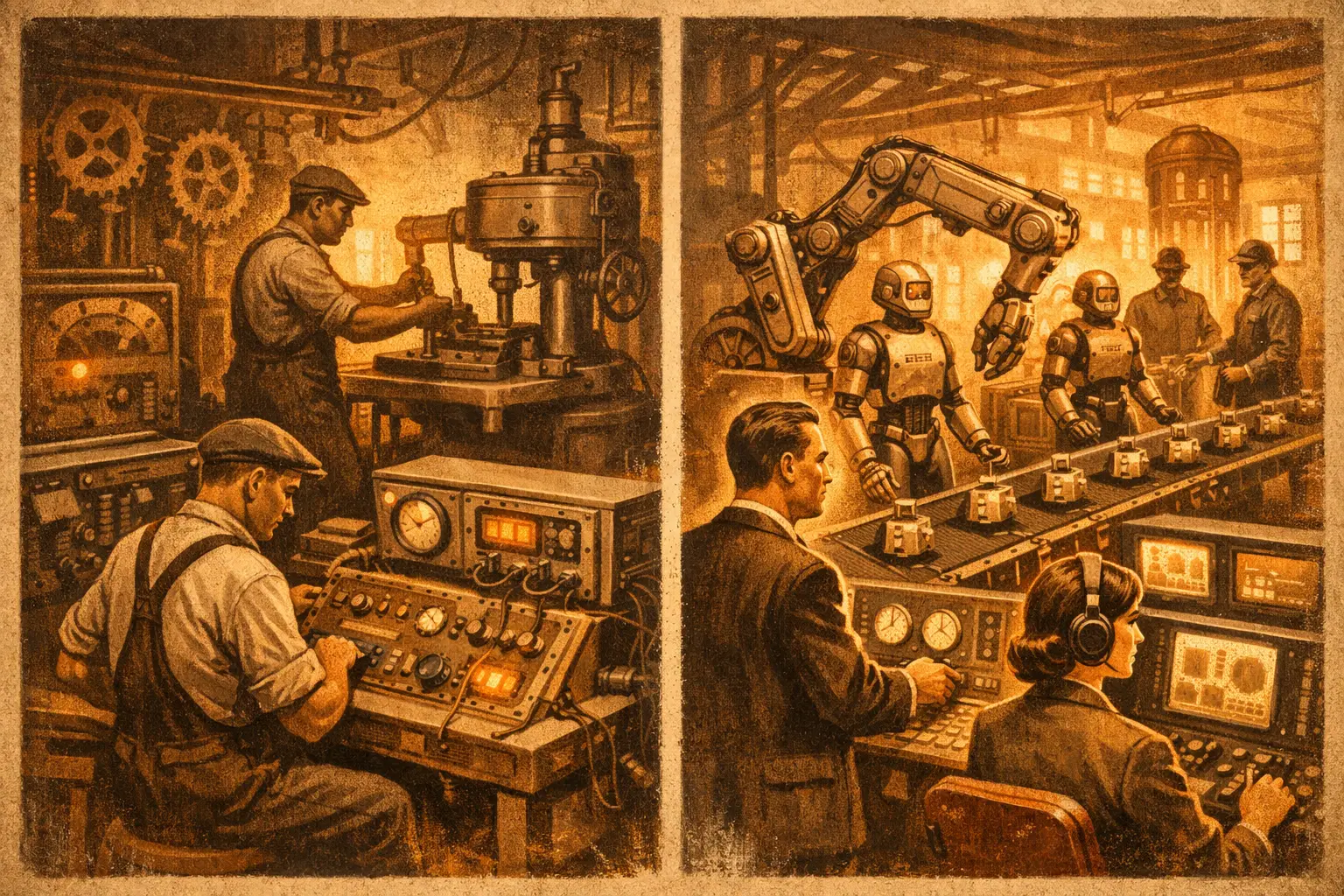
Own automation vs. service provider: Who keeps it running after go-live?
Most automation projects fail not because of the model, but because of a process that only works as long as an experienced person keeps exceptions in mind. A bot extracts invoices, but no one defined what happens when a purchase order number is missing. An AI agent qualifies inquiries, but the CRM contains duplicates and no binding criteria for handover to sales. The question own automation versus service provider is therefore not decided by a tool demo. It is decided by who reliably takes over this work after go-live.
Why own automation often stalls in operation
A business unit can describe a functioning process well as long as the standard case occurs. However, the operational effort rarely lies in the standard case. It lies in documents with two invoice numbers, customer inquiries without order reference, or data records that do not match the CRM.
Take incoming invoices as an example. Document processing and data extraction can capture supplier, amount, date, and invoice number. This only saves measurable time when the follow-up work is also defined: Which fields are checked against the order? What amount can be booked without approval? Who handles a case when the invoice appears twice? And how is the decision documented?
An internal team often starts with the visible part: It connects email inbox, extraction, and accounting via integrations/APIs. After a few weeks, there is an initial workflow. Then mandatory fields in the ERP change, a supplier sends a new PDF layout, or an access token expires. If no one has planned responsibility, monitoring, and exception handling, the automation stalls—often without being noticed immediately.
This is not an argument against in-house implementation. It is an honest description of operations. Whoever builds internally does not only take on development, but also version changes, permissions, error analysis, data quality, and the technical maintenance of rules.
Own automation vs. service provider: Decide based on operational work
The meaningful question is not: Can we build this ourselves? Many teams can set up a workflow. The clearer question is: Can and do we want to be operationally responsible for it over twelve months?
Own automation fits when three conditions are met. First, there is a stable, frequent process with a clear owner in the business unit. Second, a technical role is available to handle integrations, APIs, error logs, and changes. Third, there is a fixed procedure for exceptions so that employees do not improvise for every special case.
This applies, for example, to a company that receives structured leads daily from a uniform form. Criteria such as industry, company size, and region are clear. The team can maintain CRM enrichment, duplicate checks, and assignment to the right contact person internally. If an interface fails, a technical owner detects it via monitoring and corrects the workflow. The benefit is measurable: The sales team only receives data records that meet defined minimum requirements.
A service provider makes sense when the process is business-critical but no permanent operational role is planned internally. This is especially true when multiple systems interact or when the workflow deals with unstructured data. A voice agent that schedules appointments, for example, needs clear conversation boundaries, escalation to humans, data protection rules, CRM integration, and ongoing quality controls. The project does not end when the agent takes the first call.
The service provider should not only deliver but also take over named operations: monitoring, response to error messages, adjustments to interfaces, and an agreed procedure for changes. Otherwise, you buy external development and keep exactly the operational work that no one planned internally.
Test the process on a concrete case
Before deciding between in-house development and external responsibility, take a process with volume and friction. Not the largest, but one whose results can be verified. Good candidates are the pre-qualification of incoming inquiries, document review before manual approval, or the transfer of recurring data between specialist systems.
Describe a single process from start to finish. For an incoming customer inquiry, “record inquiry” is not enough. Note which channel it comes from, which data may be missing, which criteria apply for prioritization, and when a human must take over. Only then does it become clear whether you are automating a workflow or just an idea.
Then define four operational metrics: cycle time, share of automatically completed cases, number of exceptions, and processing time per exception. Without these numbers, you cannot clearly assess after three months whether the process reduces work or just shifts it elsewhere.
For regulated processes, additional checks are required. In KYC or KYB workflows, a system must not only categorize documents. It must record which data source was used, which rule flagged a case, and who approved a deviating decision. For AML-relevant indications, defined escalation paths are needed. For digital signatures, eIDAS may be relevant. Here, a human-in-the-loop is not an admission of an incomplete system but a controlled decision chain.
What must really be available internally
Internal teams often underestimate the time between two improvements. A process owner must decide on business rules. A technical role must manage permissions and fix errors. A backup person must take over during vacation or illness. If one of these three functions is missing, the process depends on individuals.
Documentation is also part of the system. You don’t need long manuals, but a traceable description: data in, decision, handover, exception, return path. If you have to search for the original creator in case of an error, you cannot provide a reliable operational commitment.
What a service provider should concretely deliver
An external partner should start with a defined process, not a blanket automation promise. Before building, input data, target system, decision rules, exceptions, and acceptance criteria must be established. After building, monitoring, clear response times, and a change management process are included.
Ask specifically: Who checks failed runs? How are incorrect extractions corrected? What happens when an API changes? How is reconciliation performed when two systems show different statuses? And who informs your business unit before an error leads to stalled cases? Good answers name roles, times, and processes. General statements about intelligent systems are not enough.
The pragmatic approach: build narrowly first, then expand
The decision does not have to be permanently either in-house or external. A pragmatic model separates development, operations, and competence building. A partner can initially build a critical process and operate it with clear SLAs while your team builds process knowledge and daily control. Later, operations can fully transition internally, or the partner can remain responsible for monitoring and complex changes.
This division only works with a clean handover. Your team needs access to process documentation, exception handling rules, relevant access data, and metrics. Conversely, the partner needs a binding contact person who makes business decisions promptly. Otherwise, technical changes wait for internal approvals while the process continues.
At CINDR.LA, work therefore does not start with a general AI initiative but with the verifiable process: What comes in, what can be decided automatically, where does a human intervene, and who operates the system afterward? This is clearer than a large program and reduces surprises in operation.
Who runs when something deviates?
The best automation goes unnoticed in the standard case. It becomes critical when a document is unreadable, a CRM field is missing, an external service does not respond, or an unusual case occurs. Then, not just an error message is needed, but a person or team with a mandate and access.
Plan for three levels. Monitoring detects when a run fails or takes unusually long. Exception handling assigns the case to a person and provides the necessary information. Root cause analysis prevents the same error from recurring in the next run. This chain makes a process reliable, not the number of connected tools.
Therefore, evaluate own automation versus service provider based on responsibility in exceptional cases. If your team can quickly decide on rules, realistically plan technical maintenance, and measure the process, in-house operation is often correct. If expertise is scarce, availability must be guaranteed, or the process is under high control, a managed service is often the cleaner choice.
The useful decision does not feel spectacular. It is documented, measurable, and clear to all involved: who decides, who fixes, and who checks on Monday morning whether the process is still running. This way, no surprises arise—and automation remains what it should be: operationally useful work that is reliably done.